Most arguments about the economy start with a label. Someone is for capitalism, someone else is for socialism, and within a few minutes the conversation is really about which word you trust rather than how anything works. It is a familiar fight, and it rarely gets anyone very far.
There is a more useful question hiding underneath it. Instead of asking which system we should believe in, we can ask something plainer: which parts of the economy actually serve the people living in it, and which parts have stopped. That question does not care what you call yourself. It just looks at what is happening, and it turns out to be far more revealing than the label on the tin.
Why the Capitalism vs Socialism Debate Misses the Point
Part of the problem is that the two words have stopped describing real things. When people say capitalism, they usually picture a free market: lots of small businesses competing, prices set fairly, the best product winning. When they say socialism, they often picture the opposite, a government running everything from the top down.
Neither picture matches the economy most of us live in. What we actually have is a mixture, and so does almost every successful country on earth. The interesting differences between nations are not about choosing one pure system over another. They are about how the mixture is balanced, and who it is balanced in favour of.
What a Free Market Looks Like at the Supermarket
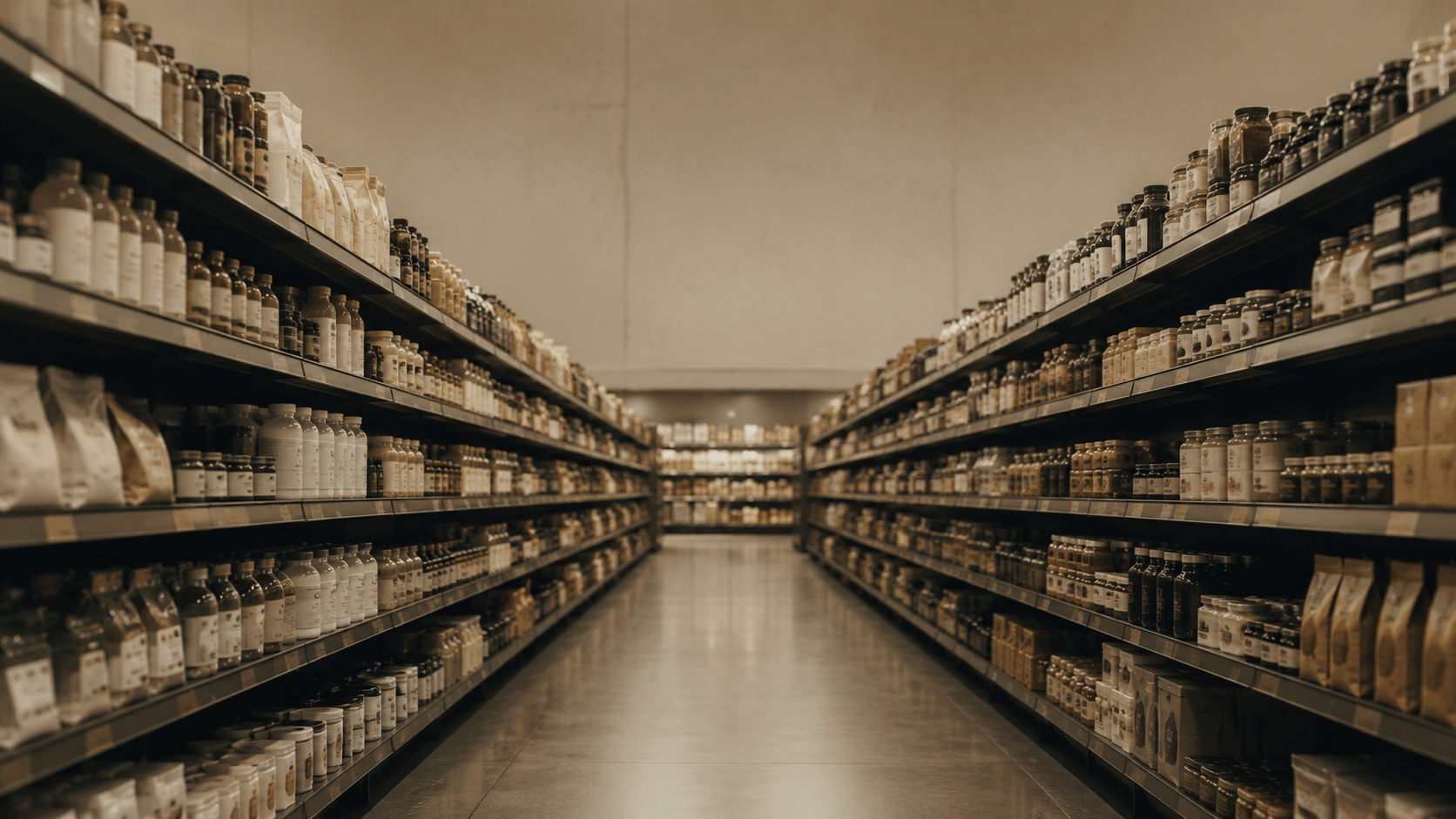
Take an ordinary trip to the supermarket. The cereal aisle alone can hold forty or fifty brands, which feels like the free market doing its job, giving you endless choice. Look a little closer, though, and most of those brands trace back to a tiny number of parent companies. The same is true of the meat counter, where a handful of firms process most of the country’s beef, and of the pharmacy, where a few large players control how medicines reach the shelf.
This matters because competition is supposed to be what keeps a market honest. When dozens of genuine rivals are fighting for your money, prices stay sharp and quality has to keep up. When the same few owners sit behind most of the labels, that pressure quietly fades. Prices can drift upward together, wages can be held down, and the wall of choice in front of you starts to look more like decoration. The market is still running. It has simply stopped doing the one thing the word free was meant to promise.

The Government Never Really Left
There is a second idea worth setting straight, and it is the one about big government versus small government. We tend to assume that one side wants the state involved in the economy and the other wants it out, and that the whole argument is about size.
In practice, the state never went anywhere. Over the same decades that “leave the market alone” became the popular slogan, governments kept spending, subsidising, bailing out, and writing rules. What changed was the direction of all that help. A great deal of it flowed towards large companies and concentrated wealth, while the supports that once steadied ordinary households were trimmed back. The government did not shrink. It changed who it was working for. Calling that arrangement a hands-off free market gets the picture almost exactly backwards.
What Markets Do Well, and What They Miss
None of this means markets are the enemy. They are genuinely good at certain things, and no one has found a better tool for them. Markets coordinate enormous, complicated chains of production without anyone needing to be in charge. They reward useful ideas, move goods to where they are wanted, and respond to information faster than any committee could.
The trouble is that markets are only good at valuing things that come with a price tag. The health of a community, clean air and water, a person’s dignity at work, whether our children inherit a liveable world: none of these show up clearly on a balance sheet, so a market left entirely to itself tends to treat them as free, and uses them up. That is not a flaw you can argue a market out of. It is simply what the tool is, and is not, built to see.
This is where the rest of society has to do its part. Decent rules, fair taxes, public services, and basic protections are how a country looks after the things the market cannot price on its own. The point is not markets against government, as if one had to defeat the other. The two do different jobs, and an economy works best when each is allowed to do the one it is suited to.
A Middle Path That Has Already Worked
If a balanced, mixed economy sounds like wishful thinking, it helps to remember that it is not a theory. It is history. For roughly thirty years after the Second World War, the United States ran on exactly this kind of mixture: strong unions, fair taxes, serious public investment, and markets that operated within firm rules. That period produced the widely shared prosperity and the broad, secure middle class that a lot of people still feel nostalgic for today.
You can see the same idea working now in the Nordic countries. They are not perfect, and they cannot simply be copied wholesale onto a much larger nation. But they keep open, inventive market economies running while making sure the gains reach most people rather than pooling at the top, and they sit near the top of almost every international ranking for health, equality, and quality of life. They are living proof that a market economy kept in service to ordinary people is a description of real places, not a daydream.
So, Which System Works?
The honest answer is that the question was never really capitalism or socialism. Both pure versions have been tried, and both concentrate power and let people down in their own way. What actually works is a deliberate mixture: markets doing what markets do well, held inside rules that keep them serving the public rather than the other way around.
That should be encouraging rather than discouraging. An economy is not a law of nature that we are stuck inside. It is a set of choices, made by people, and choices can be made differently. The evidence for better ones has been sitting in plain sight the whole time.
This is the plain-English version of a longer essay. For the full argument, the data behind it, and Mark Carney’s case for an economy built on values rather than prices, read the complete piece onTime’s Mirror.