
Essays and books for thinking people in turbulent times
Exploring how history, economics, and psychology shape the world we live in, and how we can navigate it with awareness and resilience.
The Cycle We’re In: Five Lessons from History
What the past can teach us about surviving the present. A short guide distilling the historical patterns that reveal what endures when systems fail.
Get Free GuideLatest Essays
- Essay two of three: the diagnosis. The warnings were counted, printed and purchased. Reading them was the part that failed.
- Essay one of three: the history. What the year looked like from the ground, in one American town.
- Brandeis prescribed sunlight. The Federal Reserve ended the money trust. The same lesson points at a remedy that has sat in federal law since 1986.
Three Lenses. One World.
Every essay draws from history, economics, or psychology. Often all three at once.
Historical Echoes
From Rome to the Gilded Age to now, examining how empires rise, overreach, and decline. Understanding the patterns helps us see where we are in the cycle.
Read Essays →Economic Reality
Late capitalism, systemic burnout, and the financialisation of everything. Why your exhaustion is not personal failure. It is a rational response to an irrational system.
Read Essays →Psychological Survival
How to stay sane in systems designed for extraction. Neuro-informed approaches to navigating collapse, maintaining humanity, and building something better.
Read Essays →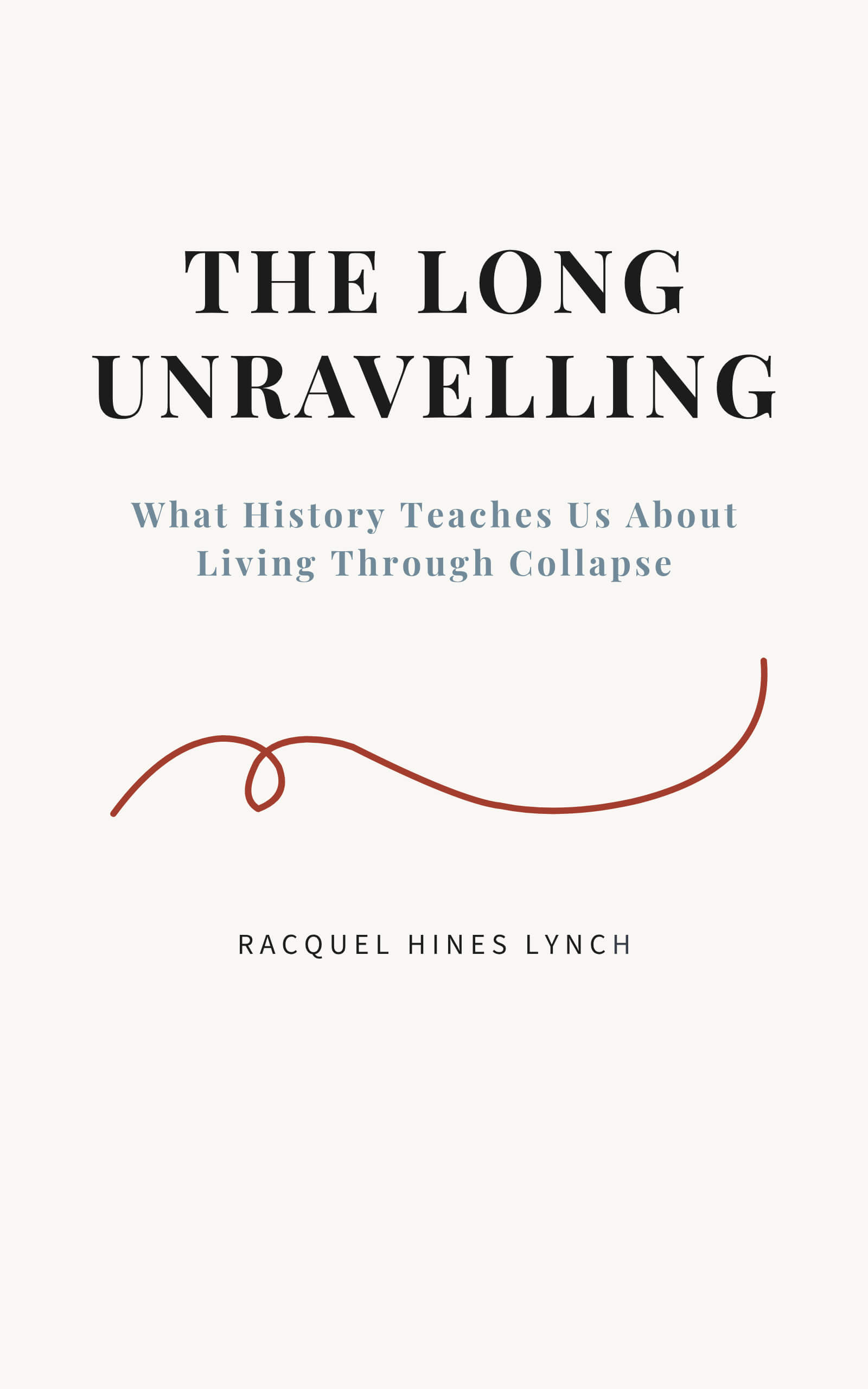
Available Now in Paperback and eBook
The eBook is $0.99 on Kindle until Tuesday, September 1. Get it now →
The Long Unravelling
What History Teaches Us About Living Through Collapse
A clear-eyed account of how late-stage systems unravel, what history teaches us about living through collapse, and how to build a life of meaning when the world is rearranging itself.
In Australia? Buy the paperback direct for $16.99 AUD →
Learn More →Free Guides
Two short guides distilling the ideas at the heart of this work. Download free, keep forever.
The Cycle We’re In
Five Lessons from History About Economic Collapse and Renewal
Every generation believes its crises are unique. They rarely are. This guide distils five timeless lessons from history’s turning points, revealing what happens when systems falter, and what endures when they do.
- When Progress Becomes Religion
- The Fallacy of Infinite Growth
- The Middle Class Mirage
- The Psychology of Collapse
- What Survives Every Time
Echoes of Empire
A Short History of Repeating Mistakes
From Rome to Silicon Valley, the story is the same: power believes it is permanent. This guide traces four civilisations to reveal how each rose, overreached, and collapsed under its own certainty.
- The Roman Lesson: Infrastructure Without Integrity
- The British Lesson: Commerce as Control
- The American Lesson: Growth as Destiny
- The Digital Lesson: Empire Without Geography
- The Human Lesson: Why We Keep Repeating
Both guides are delivered instantly via email. Subscribe to Time’s Mirror for weekly essays.

Writing to make sense of the systems we live in.
“I write to understand how systems shape our mental health, our societies, and our futures, and how we can reclaim our humanity in the process.”
I’m Racquel Hines Lynch, a writer, with a background in economics, biomedical science, and counselling (in training), exploring the intersection of history, economics, and human psychology.
For decades I’ve studied how economies grow, break, and rebuild, and how those same forces ripple through our minds and relationships.
Through RHL Writes and my Substack publication Time’s Mirror, I help readers think critically, feel deeply, and find meaning amid uncertainty. Alongside the essays, I write for organizations that train and teach clinicians.
I also write for people who train clinicians
Course pages, email sequences, articles, and the search strategy underneath them, for psychology educators, training institutes, and private practices. It starts with an audit.
See how I work