

A mixed economy is one in which private enterprise and government share the work of running a country. Markets handle most buying, selling, and production, while the state provides certain services, sets the rules, and steps in where markets fall short. Almost every prosperous nation in the world runs on some version of this arrangement, even when its politics prefer not to call it that.
The phrase turns up often in news coverage and political argument, usually without much explanation. This is a plain walk through what a mixed economy actually is, how it works, and why it has become the quiet default for most of the countries generally considered successful.
What is a mixed economy?
A mixed economy combines two things that are often discussed as opposites: private markets and public provision. Most businesses are privately owned and compete to sell goods and services, with prices shaped by supply and demand. At the same time, the government owns or funds some things directly, regulates how markets behave, and uses taxes to pay for shared services such as roads, schools, courts, and healthcare.
The word “mixed” is doing real work here. It signals that no single principle governs the whole system. Some parts of life are left largely to the market, others are handled collectively, and a great deal sits somewhere in between. Where exactly a country draws those lines is a matter of history, politics, and choice, which is why two mixed economies can look quite different from one another.
The two extremes it sits between
It helps to picture a spectrum.
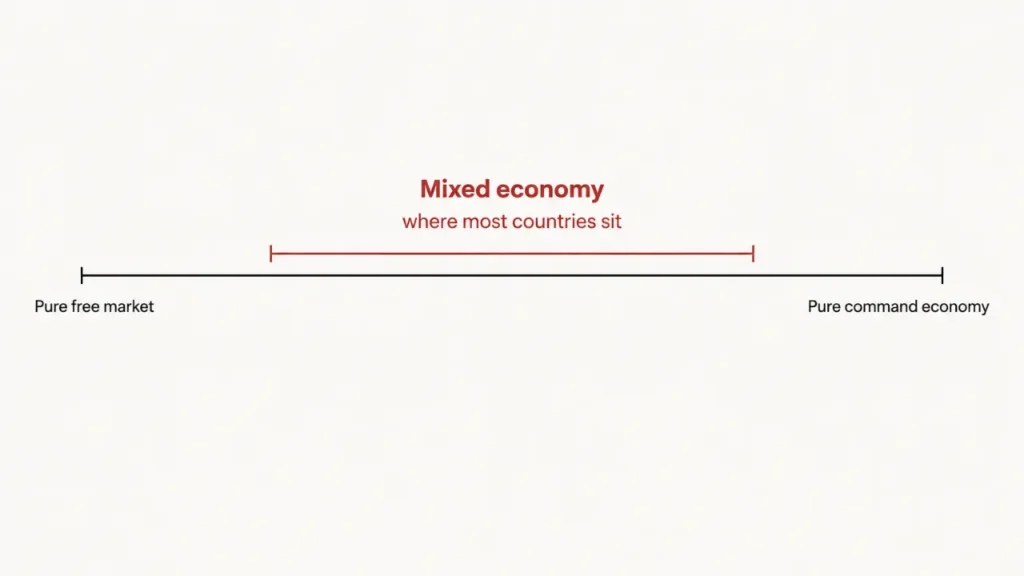
At one end is the pure free market, sometimes called laissez-faire. In this model, almost everything is privately owned, prices are set entirely by supply and demand, and the government does as little as possible. It is a useful idea for thinking about how markets work, but no country has ever run this way for long. Even economies known for light regulation still maintain courts, police, armies, and basic public infrastructure, all of which sit outside the market.
At the other end is the pure command economy, in which the state owns the major industries and plans production centrally, deciding what gets made and who receives it. Several twentieth-century governments attempted versions of this. In practice, central planners struggled to match supply to need across millions of decisions, and the systems tended to produce shortages, waste, and a heavy political cost.
A mixed economy borrows from both ends without committing fully to either. It keeps the energy and responsiveness of markets while using public institutions to do the things markets handle poorly.
How a mixed economy works in practice
In a mixed economy, markets do most of the everyday work. They decide how many cafés open on a street, what a litre of milk costs, and which products succeed or fail. This is the part of the system that rewards effort and innovation, and it tends to allocate ordinary goods efficiently without anyone having to plan them.
Government enters where markets leave gaps. There are some things markets will not supply well on their own, often called public goods: national defence, a legal system, clean air, basic research. There are also costs that markets ignore, such as pollution, which regulation exists to address. And there are outcomes markets produce that societies decide they do not want, such as people unable to afford medical care, which is why most mixed economies fund health, education, and a social safety net through taxation.
The result is a layered arrangement. Private firms produce and trade. Public institutions provide infrastructure and services. Regulation sets limits on both. Tax and welfare move resources around to soften the sharpest inequalities. The balance shifts from country to country, but the underlying structure is recognisable across most of the developed world.
Why most successful countries have one
The reason mixed economies have become so common is straightforward once you see what each part is good at.
Markets are remarkably effective at certain tasks. They process information quickly, respond to changing demand, reward useful innovation, and coordinate the actions of millions of people without central direction. What they are not good at is supplying public goods, preventing harmful side effects, smoothing out booms and slumps, or limiting the inequality they tend to generate over time.
Governments have the opposite profile. They are well placed to provide shared infrastructure, fund things that benefit everyone, cushion economic shocks, and set rules that markets will not impose on themselves. What they are generally poor at is running competitive industries, predicting consumer demand, and innovating at the pace of private firms.

A mixed economy puts each to work on what it does best. This is why the countries that tend to score highly on prosperity, stability, and quality of life, the Nordic nations, Germany, Australia, Canada, Japan, and others, all run mixed systems, even as they disagree about the details. Some lean more heavily on markets, others on public provision. Singapore, often described as fiercely pro-market, also runs one of the most ambitious public housing programmes in the world. The United States, often described as the home of free enterprise, spends enormous sums on public healthcare, defence, and research.

What these countries have in common is not a shared ideology so much as a shared pragmatism: a willingness to use both tools. The mix gives them something neither extreme can offer on its own, the productivity of markets together with the stability and legitimacy that come from shared provision. Economies built this way tend to be more resilient when crises hit, because they are not relying on a single mechanism to carry the whole load.
The question that actually matters
Once you understand that almost every successful country runs a mixed economy, the usual argument shifts. The interesting question is rarely whether to combine markets and government, since nearly everyone already does. It is about the balance: how much to leave to the market, how much to handle collectively, and which mechanisms genuinely serve the people living inside the system.
That is a far more useful conversation than the familiar contest between capitalism and socialism, which often describes pure forms that exist mainly in theory. The real choices are about proportion and design, and they are worth understanding clearly, because they shape almost everything about how a country feels to live in.
If you want to go further, I unpack that question in Capitalism vs Socialism: What Actually Works?,which looks at the specific mechanisms that tend to improve people’s lives, whatever label gets attached to them.